SONA presents IZMA XAVIER
THE ART OF UNLEARNING

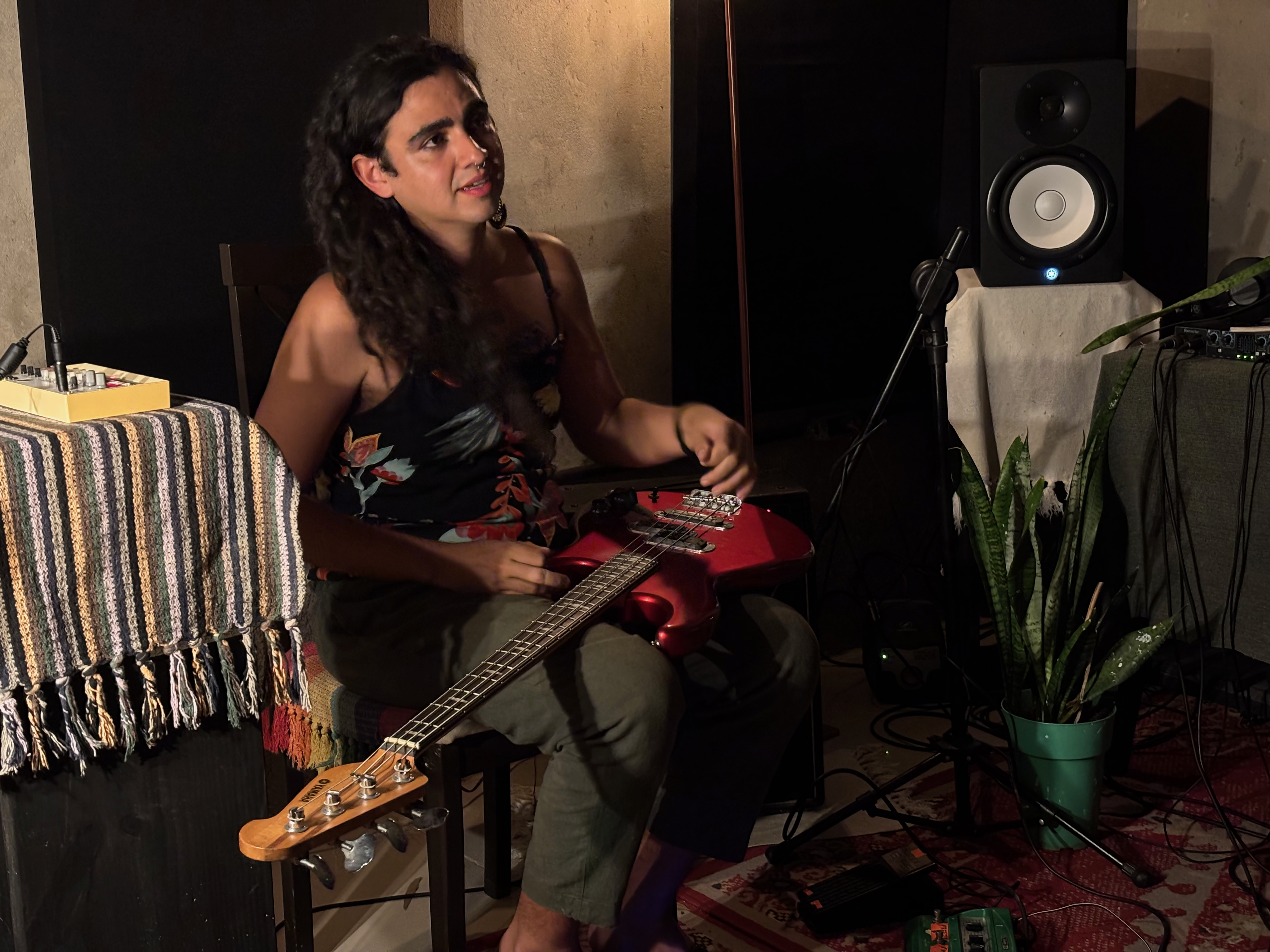
Working across Fortaleza, Camocim, and Sobral, in the northeastern Brazilian state of Ceará, instrumentalist and composer Izma Xavier has questioned the conventions of the bass guitar to build a trajectory grounded in sound experimentation.
Her relationship with music began in Camocim, amidst streets bustling with bars and her grandmother’s vinyl record shop, which, evolving with the times, later became a video rental store, video game arcade, and LAN house. The bass entered her life almost by chance when it was "left over" in a school acoustic guitar ensemble. However, what started as childhood improvisation became her true "sword and shield", the solid foundation from which all her sonic exploration springs.
Her research moves fluidly through instrumental music, soundscapes, improvisation, sampling, experimentation, and film scoring. A member of the Sobral-based band Procurando Kalu and bassist for singer and flautist Clarisse Aires, among other projects, Izma weaves her sound at the continuous crossroads between instrumental virtuosity and aesthetic subversion. She has collaborated with prominent names in Ceará's music scene, such as Mateus Fazeno Rock, Briar, and Mona Gadelha, highlighting her versatility both on stage and in the studio.
In recent years, this multiplicity led to a profound reunion with her core identity as an instrumentalist. After diving into sound art and field recording, Izma returns to the bass guitar from a fresh perspective. In her current creative space, sound is a constant laboratory where the body serves as the true origin of the music, and the instrument functions as a conductor, or a "faucet" for what overflows from her lived experience, as the artist puts it.
Part of this exploratory drive comes from a quest for identity on the strings. When trying her hand at the electric guitar, Izma first ran into the clichés of the blues and the fear of sounding like a caricature. Guided by conventional patterns and "Slash's pentatonic scale", the turning point came when her bandmates introduced her to the essence of Brazilian guitar playing. Immersion in the sounds of Mestre Vieira, the father of Amazonian guitarrada, and Northeastern forró guitar shifted her focus toward harmony and regional Caribbean and Latin roots, filling a gap that international music could not reach.
However, her dedication to this research, experienced intensely with her former band Nova Geração de Bêbados ("New Generation of Drunkards"), eventually became a trap. With the end of the group and the onset of the pandemic, Izma realized that what had initially set her free ended up trapping her creatively. "I felt somewhat limited. Something that came to liberate me trapped me later", she reflects on the period when the format grew rigid and her creative impulse called for new breakthroughs.
The breakthrough from this aesthetic paradigm came through collective dialogue, a constant driving force in her life. It was Rodrigo Brasil, a friend and guitarist for Procurando Kalu, who introduced her to the infinite possibilities of experimental music and sound art. Used to the bright, harmonic palette of guitarrada, Izma encountered atonalism, noise as composition, and sonic imagery with "more blended, less geometric colours". The experiment felt like a "banquet of new flavours". From then on, she embraced the unknown, experimenting with cassette tape recordings, mixer setups using flash drives, and rekindling her fascination with synthesizers and electronic music, an interest first sparked during her degree in Music at the Federal University of Ceará (UFC) in Sobral, under the guidance of professor Guilhermo Tinoco.
This movement between popular affective memory and radical deconstruction finds resonance in the work of contemporary Brazilian female artists such as drummer and researcher Mariá Portugal or singer and percussionist Alessandra Leão, figures who, like Izma, use improvisation and sound art to friction against the roots of Brazilian music.
During this phase, Izma's ear turned radically toward the environment. Inspired by the understanding that music-making is inseparable from the moment and physical space, she began recording in the backyard of Toca da Matraca, an independent artistic residency, creation, and education space in Sobral where she lived and worked. The organic sound of birds, wind in the leaves, and even the rhythmic hammering of local workers fused with the sound of her acoustic guitar. The resulting project, Sonhos Opacos ("Opaque Dreams"), consolidated her realization that the raw, imperfect recording tied to the external environment was exactly what the work demanded, rejecting the artificial, isolated cleanliness of recording studios.

For Izma, experimentation is never a solitary process. Throughout her trajectory, marked by intense musical and personal encounters, the force driving her deconstruction lies in collectivity. Daily life at Toca da Matraca, collaborating on theater soundtracks, and immersive theatrical processes taught her that making music live and in a group directly shapes her musical intentions. Watching the performative presence of Felipe Castro on stage, listening to the sharp poetry of writer Fran Nascimento, and observing Zeca Kalu’s songwriting process served to humanize a technique that, without these companions, felt mechanical to her.
This transversal intersection between theatre, performance, and sound culminated in an epiphany during an artistic residency at the Porto Iracema das Artes school, mentored by stage director and researcher Loreta Dialla. After days of strictly corporal preparation where playing instruments was forbidden, the artists were finally allowed to make sound. The result was a transcendental, uninterrupted 50-minute performance guided entirely by intuition, sound, and movement. It was there that Izma crystallized the idea that "playing with your fingers is not enough": "My instrument is the body; the first instrument is the body. The bass guitar is the faucet through which it flows, but the origin is my body".
This investigation into the physical presence of sound aligns Izma's listening with the thinking of avant-garde and Deep Listening pioneers like Pauline Oliveros, or the more conceptual phase of Esperanza Spalding, artists for whom the body and the surrounding environment are not mere supports, but the very raw material of the musical event.
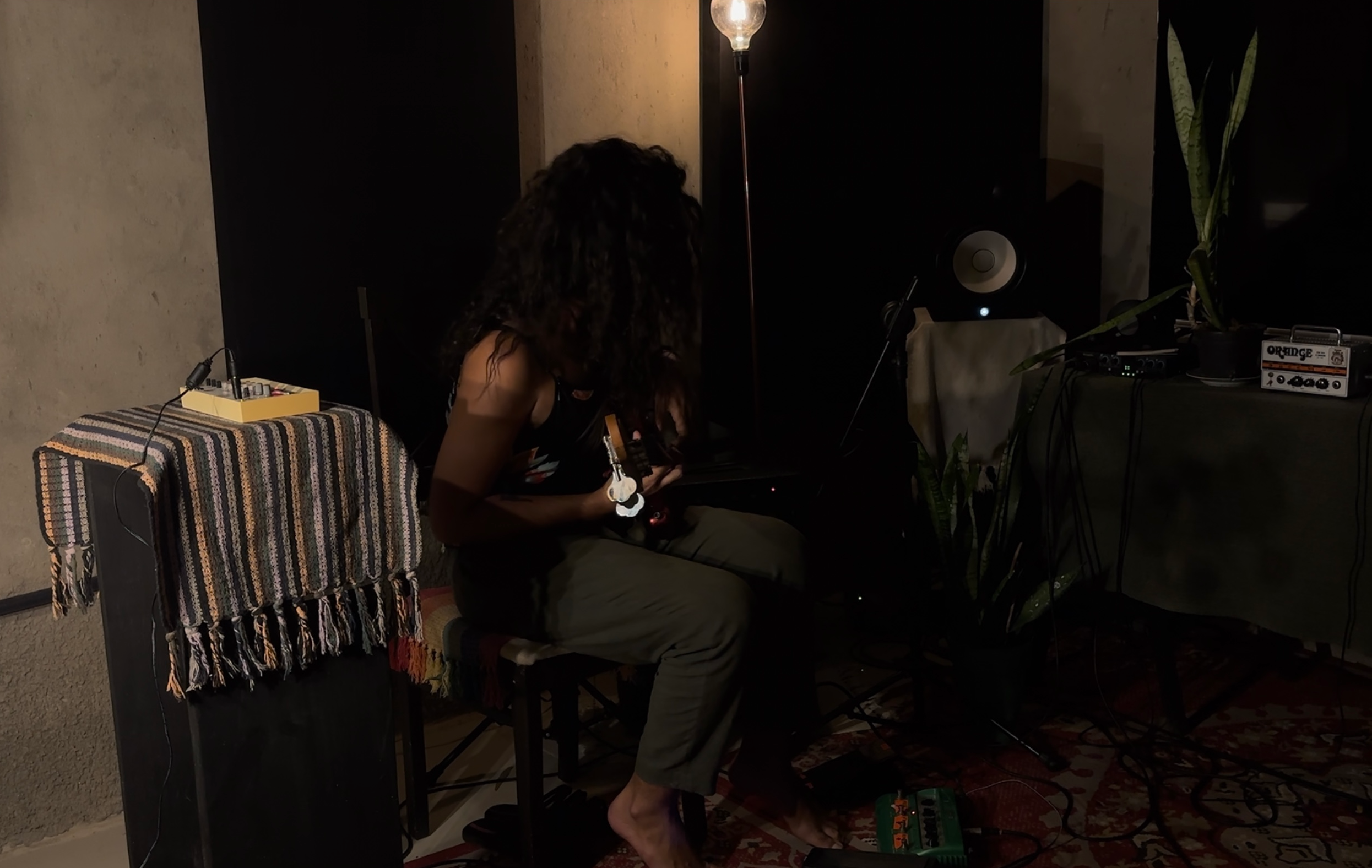
Today, Izma Xavier embraces experimentation not just as a method of listening, but as a creation tool that is always within reach. Armed with her pedals and loopers, essential for creating fissures in her compositions, she sees herself as a "mad scientist", treating her stringed instrument and its gear as her great laboratory. Believing that stagnation is dangerous to creativity, Izma seeks the unpredictable in an attempt to "break the heart of stone", in a constant process of re-sensitisation.
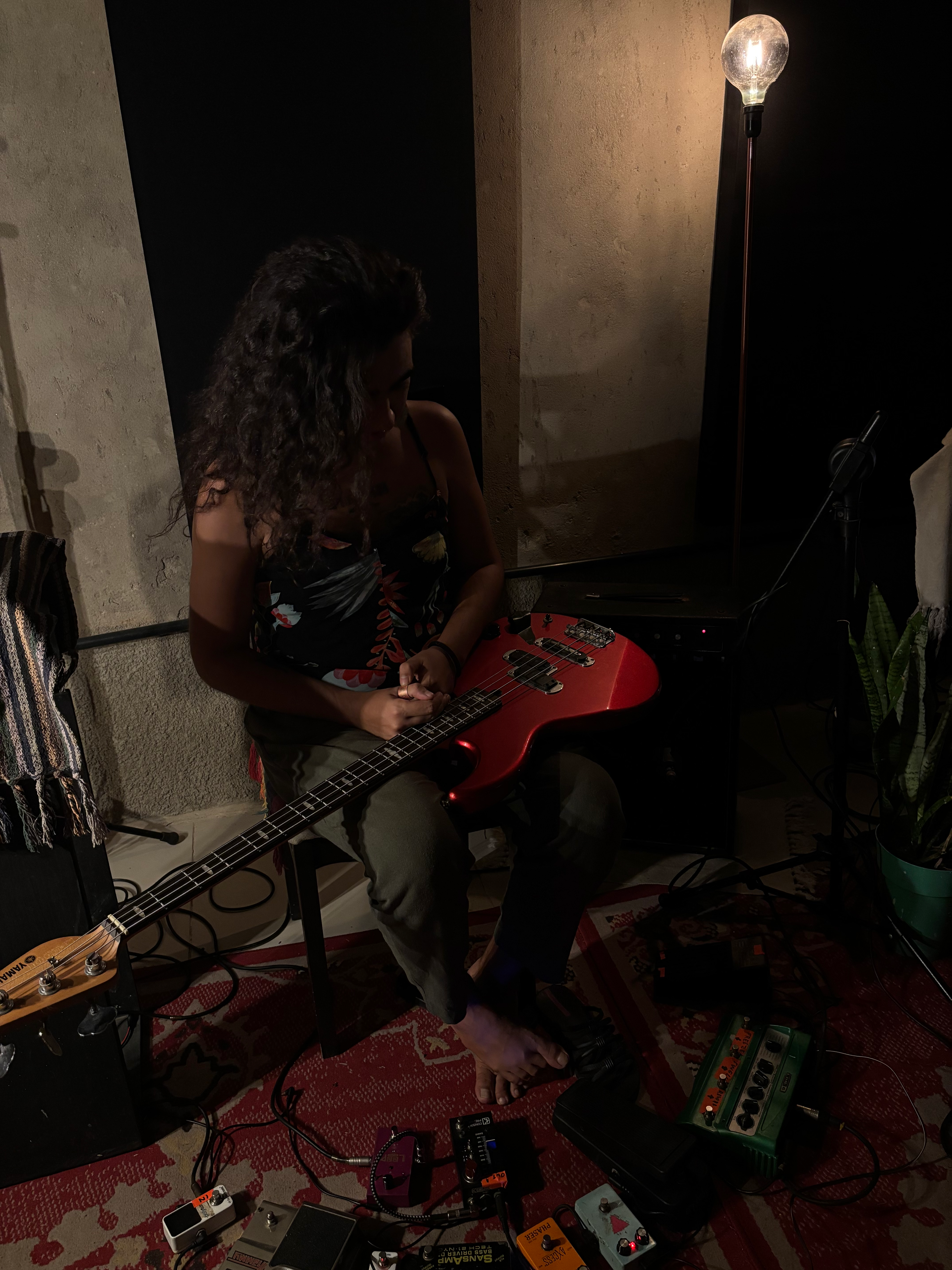
Improvisation occupies a central position. The artist redefines the very idea of rehearsal, understanding that everyday activities, like going to buy bread or crying while listening to music, are also fundamental rehearsals for the stage, as they feed the existential repertoire of the creative body. A body that, in her artistic practice, plays with its entire being.
Recorded especially for SONA, the two tracks chosen by Izma precisely illustrate the dualities of this moment. "Menta" ("Mint") explores rawness in a fluid, delicate way. The track pays tribute to her grandmother Menta, who, while not the owner of the vinyl shop, also shared a deep relationship with music and kept, among other albums, a sci-fi movie soundtrack that both frightened young Izma and sparked her sonic curiosity. Like her maternal grandfather, she passed away in the first half of 2025. Built as an intimate dialogue featuring only Izma and her bass guitar, the music acts as an echo chamber for grief. The instrument translates both the weight of absence and the hopeful resonance of emotional memory.
"Colibri" ("Hummingbird"), on the other hand, is a crystal-clear demonstration of her ability to architect rich instrumental narratives, encompassing the colours of her multiple phases. It is a track that summons the harmonies of the past, but reorganised under the surgical ear of a mature sound artist.
Together, the two works reveal a creator who needed to unlearn the rules of her own craft in order to cyclically renew her voice. By turning her body into origin and her music into a laboratory, Izma Xavier proves that an artist's most refined technique is the continuous courage to let oneself be traversed by the world.