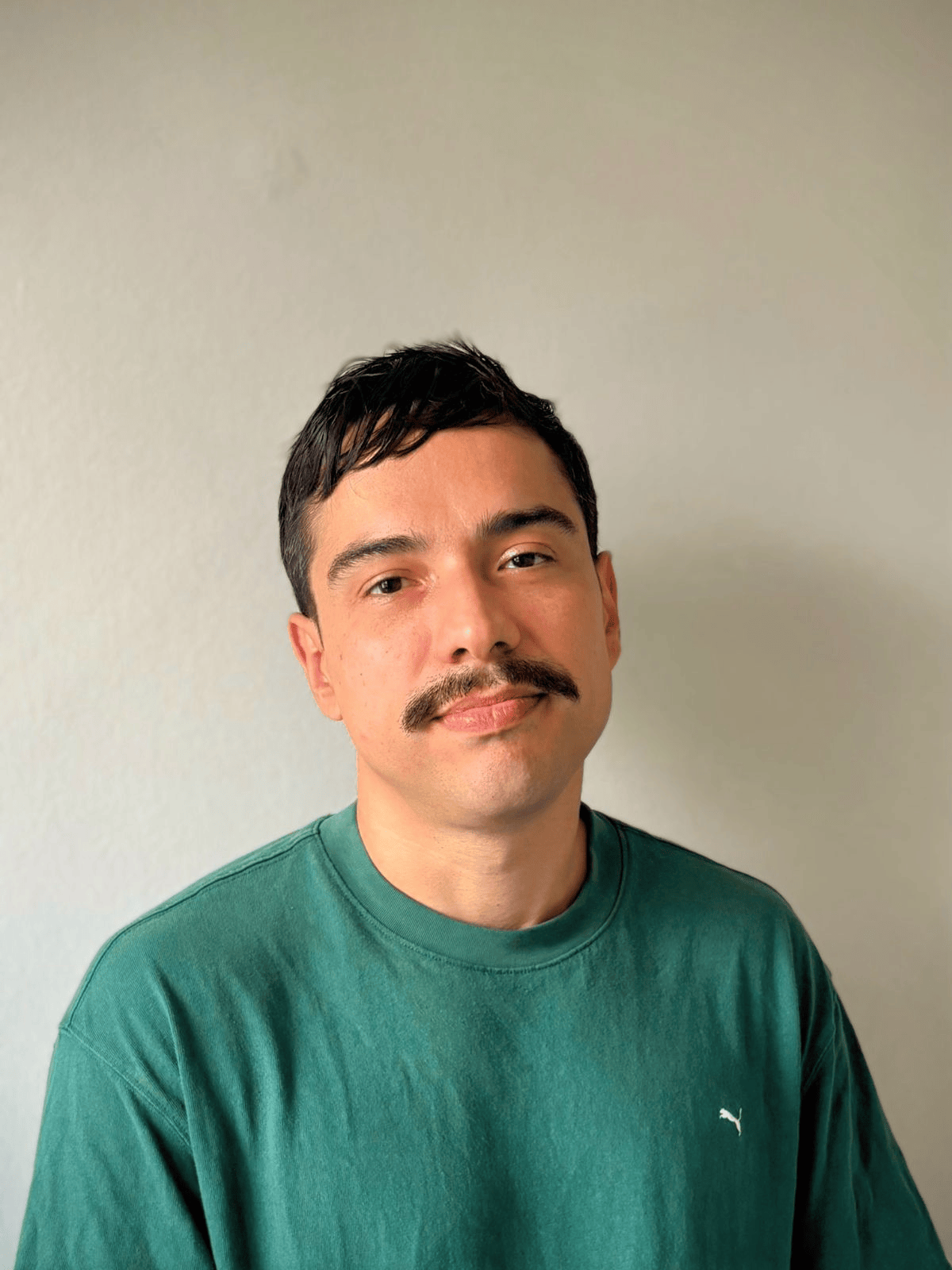
SONA presents RODRIGO BRASIL
There is a gesture of quiet insubordination running through the trajectory of Rodrigo Brasil, composer and instrumentalist from Ceará, in Northeast Brazil. In a musical culture so often ruled by the worship of technique, the pyrotechnics of solos and the performative fetish of the electric guitar, choosing to switch off one's ear to the reference points of one's own instrument can sound almost heretical. And yet it was precisely this conscious act of renunciation that allowed the Sobral-based artist to recalibrate his perception of sound and set out on a provocative, cross-disciplinary research path within Ceará's independent scene.
"For a while, I stopped listening to guitarists so I could finally hear the music. It seems that once you free yourself from the virtuosity of your instrument, your mind learns to create in a different way", Rodrigo reveals. Far from being a mere aphorism about letting go, the statement sums up an epistemological turn in his creative process, the disarming of listening itself.
In this act of emptying out, the instrument stopped being an end in itself and became a plastic catalyst. Through that opening, sound began to emerge from places previously overlooked by academic rigour or popular tradition. It came instead from the friction of soundscapes, from intuition, from the physical occupation of space and, fundamentally, from the creator's own body and emotional sensibility.
From this perspective, Rodrigo Brasil has been building a poetic ecosystem in which creating is, above all, a practice of being present. In his interview for SONA, the artist reflects on how shedding a purely technical bias opened up room for a broader kind of listening, one grounded in an approach where the body itself is the sensitive matrix from which the intentions behind his compositions spring.
To grasp the depth of Rodrigo Brasil's sonic thinking, it helps to place his work within the emotional and territorial map in which it was shaped. Sobral, an inland city and regional hub in the north of Ceará, is a territory of intense cultural friction. Cut through by the Acaraú River, the city combines the scorching heat and mystique of the sertão (the semi-arid backlands of Brazil's interior) with a distinctive academic and artistic effervescence. It was within this environment of unpredictable encounters that Toca da Matraca emerged, a residency, training and independent artistic creation space that became the epicentre of a quiet aesthetic revolution in the region.
It was at Toca da Matraca that Rodrigo brought his own restlessness together with that of other artists of his generation, such as Izma Xavier and Zeca Kalu, giving rise to projects that would challenge the logic of cultural production in Ceará's interior. Among them stands out the band Procurando Kalu, founded in 2013, of which Rodrigo is one of the creators, guitarists and aesthetic directors. Defining its early sound under the provocative label of Tropical Indie and later expanding into art-rock and experimental music, Procurando Kalu built a body of work in which popular song embraces theatre, poetry, noise and performance.
In Procurando Kalu, Rodrigo's guitar does not try to lead the arrangement in a hierarchical way. On the contrary, articulated in direct dialogue with synthesisers, distorted basses, organic percussion and the performative presence of Zeca Kalu and Felipe Castro, Rodrigo's guitar works as a textural layer, a chromatic element of friction. The band has become something of a living laboratory, where traditional northeastern Brazilian genres, such as baião and guitarrada, meet atonal deconstruction and contemporary noise.
Alongside the band, the Toca da Matraca ecosystem allowed Rodrigo to develop a deeply communal and contagious way of working. Creation was understood as a process of mutual contamination. Artists orbiting the same space found in Rodrigo a generous interlocutor, capable of stirring up pedagogical doubt and a hunger for the unknown and for reinventing one's own instrument.
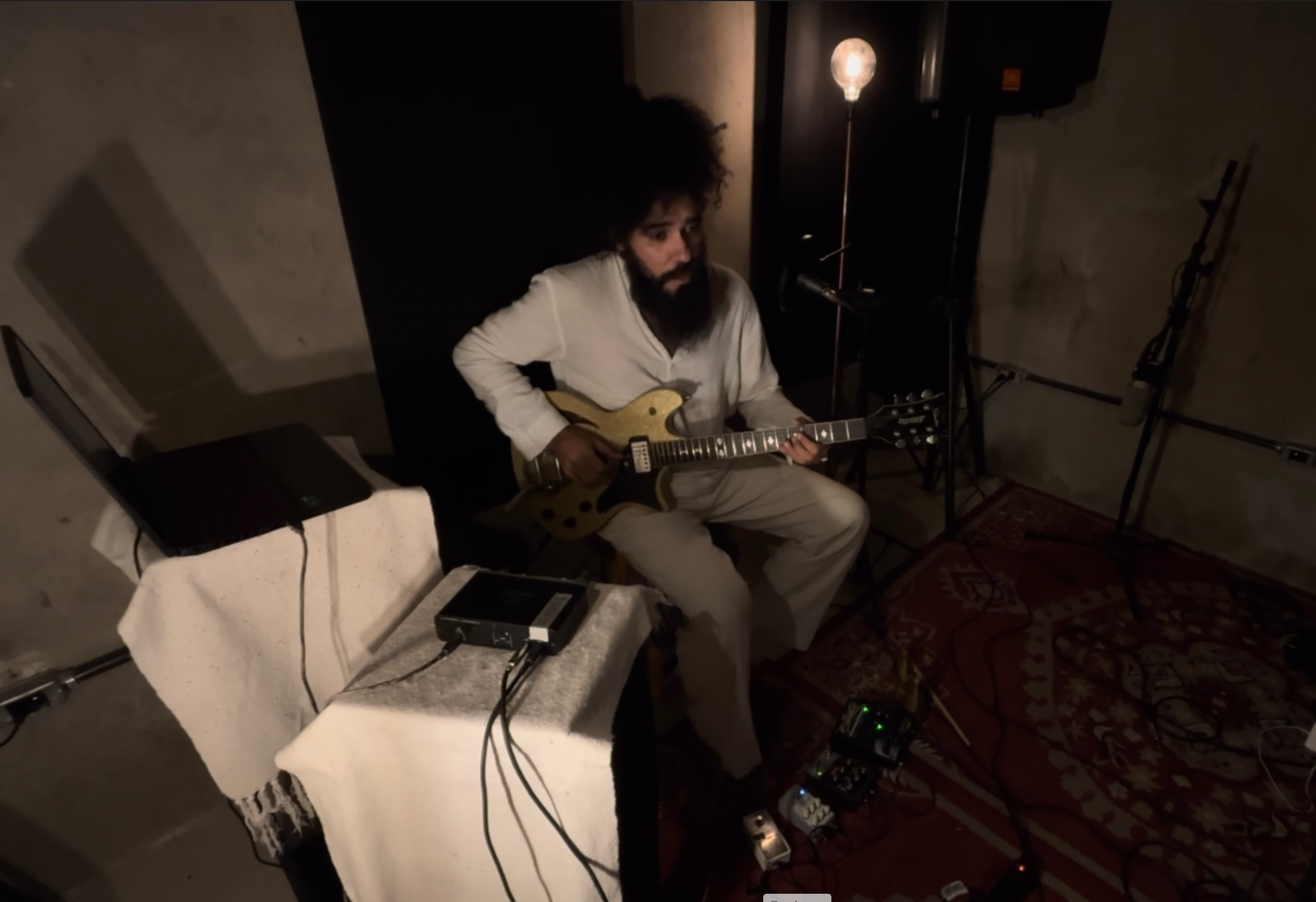
The history of the electric guitar in the twentieth century is, to a large extent, a history of virtuosity. From Chicago electric blues to heavy metal, by way of 1960s psychedelia and contemporary math rock, the instrument has been invested with an almost mythical aura, tied to speed, physical command of the fretboard and the assertion of the player's individuality. That model, while it has produced some of the defining moments in the history of popular music, tends to create rigid aesthetic traps. Guitarists frequently fall back on habits of muscle memory, one hand automatically reaching for the scale shapes learned in youth while the other repeats well-worn rhythmic patterns.
When Rodrigo Brasil says he stopped listening to other guitarists in order to "hear the music", he is describing an act of poetic detox. The aim was not to reject the instrument's history, but to loosen the guitar from its fetishistic constraints.
Out of this need to push the investigation of the instrument further came the project Contra Espelho, an experiment-cum-research effort focused on the possibilities of the deconstructed guitar, the use of degraded cassette tapes, effects pedals pushed to the very edge of feedback, and experimental painting. In Contra Espelho, the guitar becomes an investigative vehicle for familiar sounds rendered unfamiliar through disarray and hollowed-out timbres. In this way, Rodrigo Brasil places himself within a lineage of creators who refuse to treat the instrument as a static tool, reshaping it instead into a field of forces in constant flux.
Once the purely technical bias is set aside, the creator's mind begins to operate through architecture and sonic sculpture rather than through the sequencing of notes. The question stops being "What chord comes next?" and becomes "How dense should this texture be in space?" or "How does this sound change the temperature of the room?"
If pure technique is abandoned as the main guiding principle, what takes centre stage in Rodrigo Brasil's creative process? The answer the artist gives in his interview for SONA is unambiguous: the body and emotional sensibility.
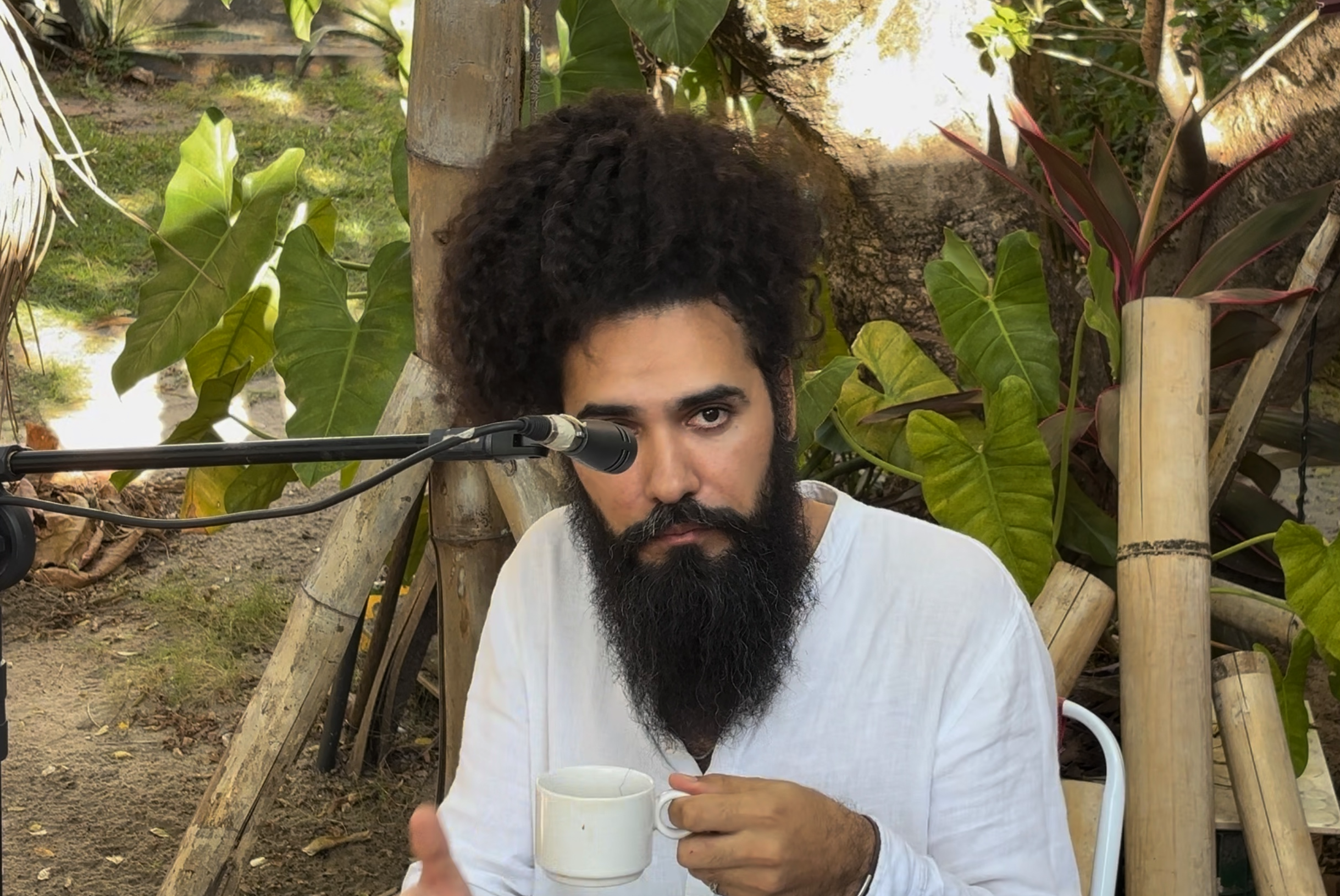
Historically, the Cartesian tradition of the West tried to separate the mind, the seat of reason and musical structure, from the body, a mere biomechanical executor. Rodrigo pushes against that divide, arguing that composition is a fully embodied act. Sound, in his view, springs from the artist's state of physical presence, from breathing rhythm, from tired muscles, from posture, from the emotional memories held in the skin.
This physical, sensory dimension becomes even more evident in Rodrigo's partnership with performer and researcher Felipe Castro on the project Corpoco. Conceived as a scenic-sonic proposition, the performance explores urban non-places and the dynamics of passing through and dwelling within the city. In Corpoco, the sound produced by Rodrigo's guitar and the movement of Felipe's body function as a single substance pulled taut in real time. The guitar responds to the performer's movements through space, while the performer reacts to the shifts in density and noise coming from the amplifiers. Sound becomes tangible, a physical presence that collides with the urban architecture and reshapes how the audience present perceives it.
By placing emotional sensibility at the centre of his practice, Rodrigo turns the act of making music into an exercise in vulnerability. The artist's compositions are shaped by the human relationships around him, by accumulated grief, by loves lived, by the landscapes of the sertão and by daily life alongside his creative partners. Music becomes a diary of emotional resonances, in which every sound carries the trace of a real lived experience.
The broadening of Rodrigo Brasil's listening is also a direct result of his academic background and his multidisciplinary practice. During his degree in Visual Arts at the Universidade Estadual do Ceará (UECE), a public university in the state, the artist carried concepts of spatiality, colour, texture, contrast and plastic composition, typical of painting and sculpture, into the field of music.
In the visual arts, the blank space of a canvas is a latent presence. In much the same way, in his sonic compositions, silence and background noise form the negative space against which textures are projected. His experience with the plastic arts allowed Rodrigo to think about music in chromatically richer terms. Rather than working solely within the geometric palette of traditional chords, he began manipulating "sonic paints" made up of low frequencies, electromagnetic interference and analogue crackle.
This plastic sensibility found extremely fertile ground in cinema and audiovisual work. Rodrigo has signed the direct sound and original score for a number of notable short films, including Límite I (2024), winner of Best Experimental Short at the Festival Internacional de Cinema Respira, in the southern state of Rio Grande do Sul (RS), and Best Sound at the Festival Cine Meru, in Ceará (CE); Límite II (2025); and the project Atro-Cidade: Desvios Sonoros Visuais (2022), all directed by Thamires Coimbra, a fellow Sobral-based artist with whom Rodrigo has maintained a rich partnership since 2020.
In Rodrigo's research, sound operates as an autonomous, invisible character, capable of contradicting the image, building layers of ghostly memory or adding tension to the narrative. For him, this practice has fed directly back into his work as a guitarist and composer. The hyper-attentive listening demanded by cinema taught him to bring to his music that same richness of detail and the same attentiveness to the microsounds that inhabit everyday life.
One of the most striking features of Rodrigo Brasil's impact on Ceará's cultural scene is his role as a provocateur and catalyst for the work of other artists. The knowledge and research Rodrigo has developed do not stay locked away as a private hoard of technical secrets, but circulate generously through dialogue and everyday shared life.
One telling example of this poetic contamination took place with the instrumentalist and composer Izma Xavier. A member of Procurando Kalu and a long-time collaborator of Rodrigo's, Izma had trained deeply in the harmonic richness of the bass guitar and the dynamics of northeastern guitarrada. At a certain point in her career, though, she felt trapped by the very formulas she had learned to master.
It was Rodrigo Brasil who acted as the gateway into this new world for her. By introducing Izma to the possibilities of experimental music, sound art, atonalism and the use of noise as compositional material, Rodrigo offered his partner a new chromatic palette, "with colours that are more mixed and less geometric", as Izma would describe it. This encounter transformed the bassist's individual research, culminating in works such as the project Sonhos Opacos, and also strengthened the collective dynamic of the whole scene they were part of.
This horizontal, pedagogical way of working reveals an ethical stance towards art. In a cultural market often driven by competition and individualism, Rodrigo's practice bets instead on building networks of affection and shared creation. By challenging his fellow artists to step outside the comfort of technical habit, Rodrigo helps to consolidate an artistic practice in which doubt, experimentation and the courage to get things wrong are celebrated as fundamental values.
His work in collaboration with artists across different disciplines, from the performative rock of Buhr to the buzzing scene around Mateus Fazeno Rock, by way of the electronic experiments of Clau Aniz and the conceptual art of Felipe Castro, shows the versatility of a creator equally at home on the main stage and behind the scenes of sonic research.
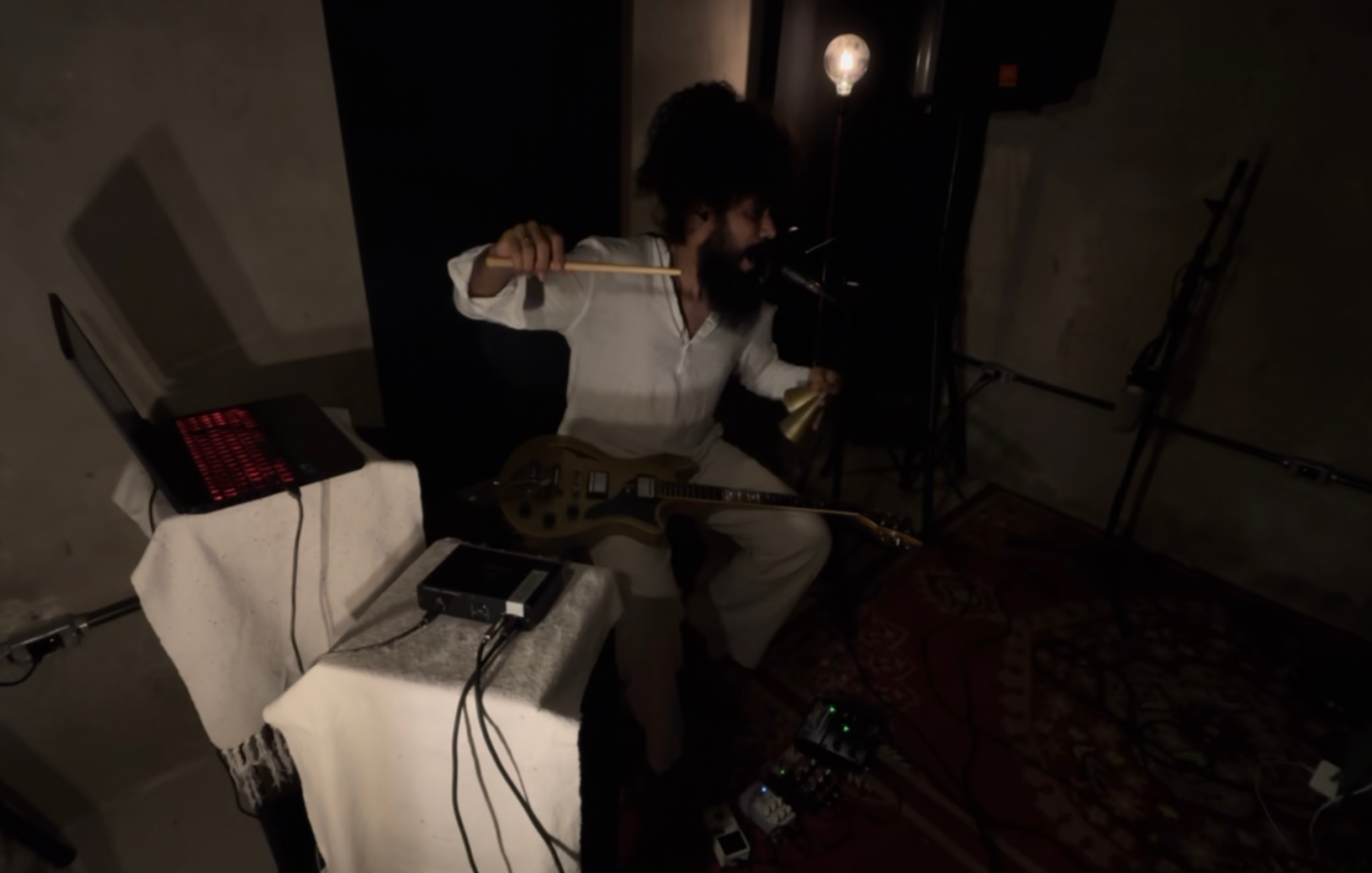
The two unreleased compositions Rodrigo Brasil recorded specially for this edition of SONA work as a sonic compendium of his theoretical reflections, presenting the artist at his most intimate and investigative.
In "A pedra de se ver", the sense of time comes from a continuous cowbell loop, over which the guitar builds a sound that is at once dry, heavy and delicate. The instrumental line shifts between a low, faintly apocalyptic ambience and well-placed high notes that cut through the texture. With no attachment to lyrics or words, the voice manifests itself in cries that work like calls, exploring the body's own resonance and vocal texture as the primary instrument.
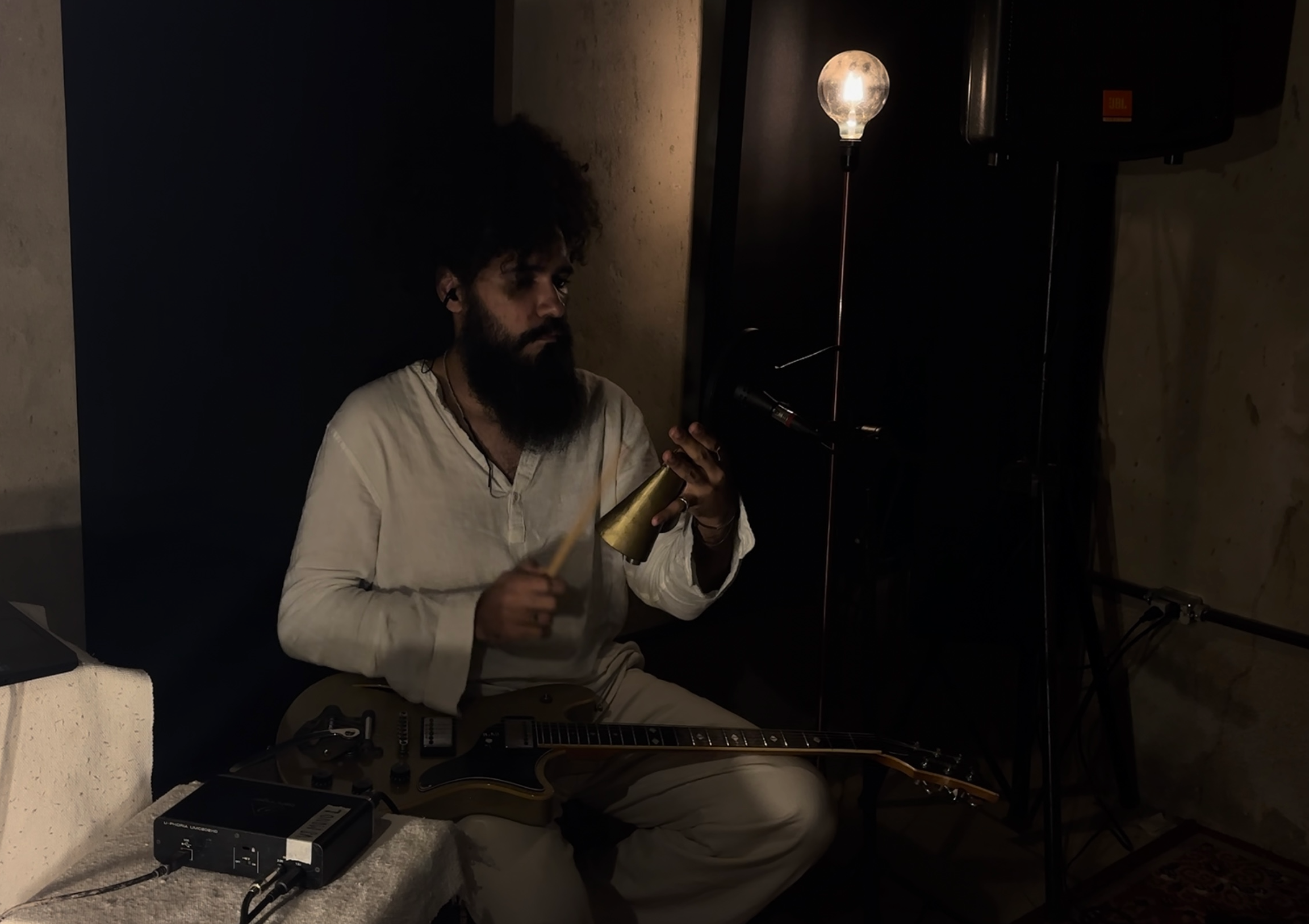
"Quarto escuro" is driven by a percussive cowbell loop played with drumsticks, generating a hypnotic pulse that evokes traditional rhythmic matrices from Ceará, such as coco, reisado and maracatu, regional folk rhythms tied to celebration and ritual. The voice takes on a noisier, more animalistic tone, tinged with foreboding, while the guitar feels its way through melodic micro-rhythms. The instrument seems disoriented at first within the arrangement, but gradually finds its way as it embraces that combined chaos.
The recordings made for SONA show experimentation at its most physical. Between the percussive pulse, the bared voice and a guitar that seeks its own logic through error, Rodrigo Brasil reaffirms artistic practice as a fundamentally free space.